Hua Hin · 27 September 2026
Hua Hin Beach Clearance: What the Long-Running Waterfront Dispute Means
A disputed stretch of Hua Hin’s historic waterfront is again at the centre of proposed clearance work. Here is how the court ruling, residents’ claims and the municipality’s plans relate to one another.
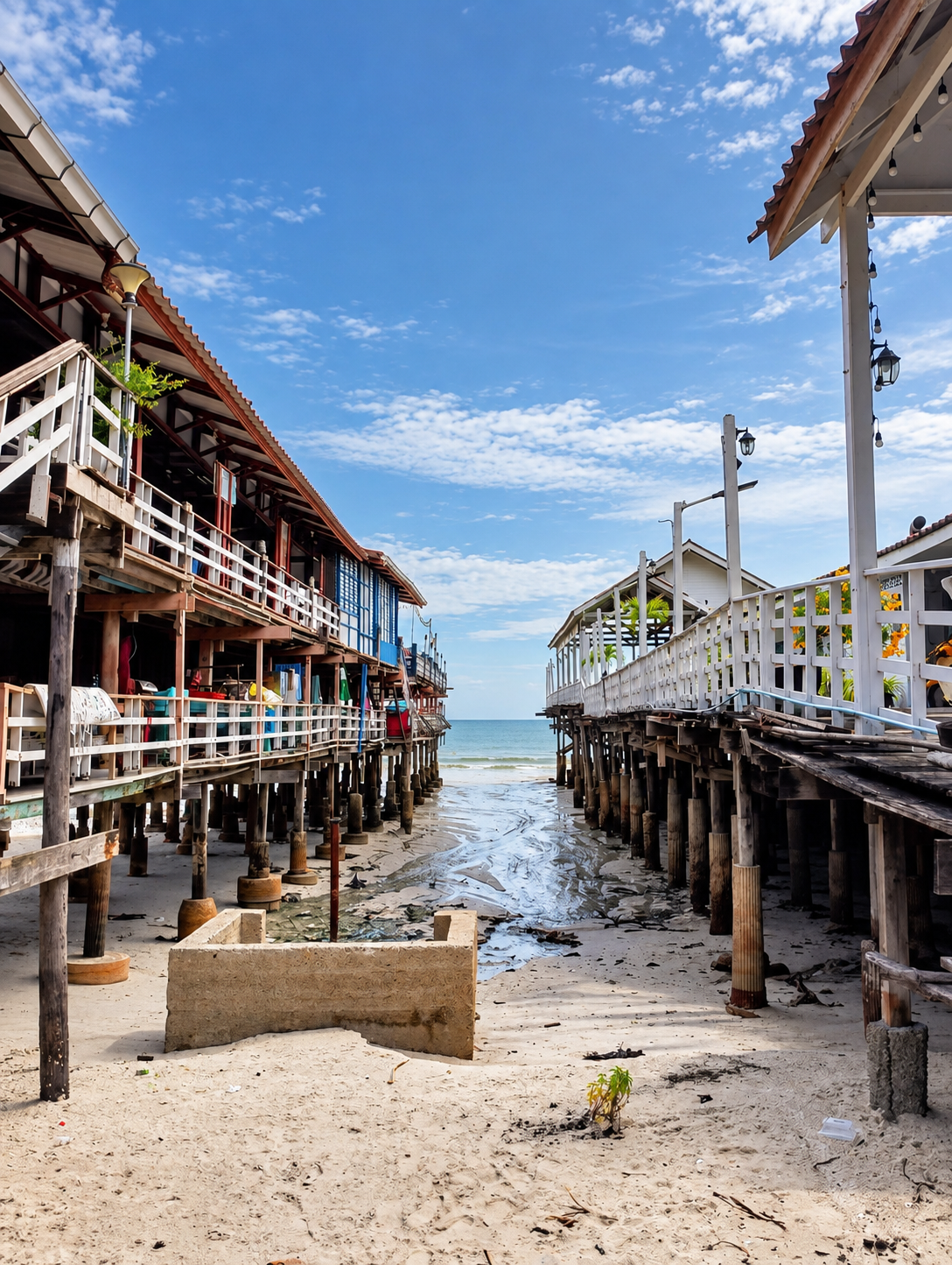
A particular stretch of shoreline
The dispute concerns waterfront structures along Naresdamri Road, between Hua Hin Fishing Pier and the Chao Mae Thap Thim shrine. It is not a clearance of Hua Hin’s coastline as a whole. Restaurants, guesthouses and homes have occupied parts of this area for many years; some structures extend over the shore or water.
Hua Hin Today’s account of the area’s history traces the dispute back at least to 2002. It reports that some owners removed buildings voluntarily, while others challenged removal orders. The waterfront’s long association with fishing and small businesses is part of Hua Hin’s history, but it does not itself determine the legal status of the land.
The stakes extend beyond the buildings in question. How public coastal land is managed affects access to the beach and the protection of the shoreline. At the same time, decisions about a familiar part of the town affect people and businesses with longstanding ties to it. Public access, management of coastal land, Hua Hin’s historic waterfront character and the circumstances of longstanding occupants all form part of the wider context; none determines the outstanding individual claims on its own.
What the courts have decided
The Bangkok Post reported on 25 September 2026 that a 2014 Supreme Administrative Court ruling upheld the municipality’s demolition and land-use orders for the structures, which the court found had been erected illegally on public beach land. That ruling addressed the legality of the structures and the orders for their removal; the residents’ broader claims to ownership or a right to occupy the land were not determined by it. Hua Hin Today has also documented the intervening enforcement efforts and legal challenges. The ruling and the subsequent attempts to implement it are established parts of the dispute; the timing of any further clearance remains subject to the legal process.
According to the Bangkok Post, Hua Hin’s mayor said the municipality signed a demolition contract on 24 September 2026. He announced a 120-day work period beginning on 25 September for 15 buildings, while another 11 fell under the Marine Department’s budget. The newspaper reported that no demolition work was observed on 25 September. The announced programme should not be mistaken for confirmation that the work was completed or that pending applications were decided.
What residents are asking for
Some residents have sought recognition of a right to remain and have applied to Hua Hin Provincial Court for temporary protection. Others have accepted the existing ruling, according to Hua Hin Today’s 25 September report. A residents’ representative told reporters that a previous petition to establish occupancy rights had not been accepted and that residents were appealing.
Residents have pointed to family history, house registrations, utility connections and, in earlier accounts, records such as tax receipts as support for their position. These are claims advanced by occupants, not a court determination that they own the land or have a legal right to occupy it. Long-term occupation or administrative records do not automatically establish ownership or a right to remain on public land. Their request for recognition and temporary protection is separate from the existing Administrative Court ruling on the structures.
The mayor said officials were awaiting the court’s response to the application for temporary protection. He maintained that, absent an order preventing the work, agencies were obliged to proceed with the removal orders. That is the municipality’s stated position, not a decision on the residents’ outstanding application.
What it could mean for Hua Hin
Beyond the legal dispute itself, the longer-term question is what happens to this part of Hua Hin’s waterfront. If the clearance ultimately proceeds, it could create an opportunity to improve public access, enhance the beachfront environment and reconsider how this historic stretch of coastline is used in the future.
For a town whose identity has always been closely connected to the sea, the outcome will help shape an important part of Hua Hin’s waterfront for years to come.
The case remains subject to ongoing legal proceedings. The position reported here reflects information available as of 27 September 2026 and may change as the courts and authorities consider the outstanding applications.
This article is provided for general information and is not legal advice.
Sources & Further Reading
The Vista Hua Hin
Stay updated
New stories from Hua Hin.
Receive new Journal articles, local insights and occasional updates from The Vista Hua Hin.