Property · 8 September 2026
Understanding Chanote: The Structure of Full Land Title in Thailand
In Thai real estate, the classification of land documentation determines the extent of ownership rights, spatial certainty, and transactional security. Among the various land papers issued by the Land Department, the Chanote deed stands as the definitive instrument of absolute private ownership.

Navigating land acquisition in Thailand requires a clear understanding of the country's titling framework. Land rights range from possessory claims and agricultural use permissions to fully registered, freehold titles. For prospective purchasers seeking absolute legal clarity, understanding the specific mechanics of the Chanote title is essential.
The Hierarchy of Thai Land Documents
The Land Department of Thailand administers several classifications of land documentation, each conveying different legal standing. Lower classifications, such as possessory certificates or certificates of use, do not confer absolute ownership. Intermediate titles, including forms of Nor Sor 3, record occupancy and use rights, but may rely on relative boundary surveys that reference local landmarks rather than fixed geodetic coordinates.
Over time, certain intermediate classifications such as Nor Sor 3 Gor can be upgraded, but they do not inherently offer the ultimate status of a true title deed. The distinction between these land papers is not merely administrative; it governs whether a parcel possesses definitive borders, whether it can be divided, and the precise legal process required to execute a transfer.
Defining the Chanote (Nor Sor 4 Jor)
The Chanote, formally designated as Nor Sor 4 Jor (or Nor Sor 4), is the highest classification of land title deed in Thailand. Characterised by the red Garuda (Krut Daeng) emblem stamped at the head of the document, it constitutes a certificate of true ownership issued under the Land Code.
Unlike documents that merely confirm possession or use, a Chanote establishes indisputable private freehold ownership. The reverse side of the deed records the complete, unbroken chain of legal transactions, detailing past and present registered owners, encumbrances, leases, servitudes, and mortgages. This public ledger, mirrored in the official records at the Provincial or District Land Office, ensures that title rights are transparent and verifiable.
Cadastral Accuracy and GPS Boundaries
A defining characteristic of the Chanote deed is its spatial precision. While earlier or lower-tier land certificates rely on aerial photographs or approximate physical landmarks, a Chanote is surveyed by Land Department surveyors using a national geodetic network and GPS coordinates.
During the survey process, numbered concrete markers or metal pegs are driven into the ground at every corner and boundary intersection of the plot. These markers are linked directly to official Land Department cadastral maps. The resulting deed features an exact scale diagram of the parcel, showing its dimensions, adjoining properties, public access ways, and marker numbers. This degree of accuracy significantly reduces the risk of boundary overlapping, encroachments, and title disputes with neighbouring landowners.
Legal Certainty and Transactional Capabilities
Holding a parcel under a Chanote deed unlocks the full spectrum of property rights recognised by Thai law. It is the only land title deed that permits the complete range of transactions without prolonged public notice periods or possessory challenges.
A Chanote title deed permits:
- The absolute transfer of freehold ownership through registration at the Land Office.
- The legal subdivision of a parcel into smaller, independent plots with individual titles.
- The formal registration of long-term leases, usufructs, habitations, and servitudes.
- Registration of mortgages and the use of the land as collateral for bank financing.
In practical terms, financial institutions in Thailand require a Chanote title when evaluating land for mortgage security. The presence of a registered Chanote verifies that the asset has clear legal status, which provides the requisite certainty for lending and institutional valuation.
Resale Integrity and Long-Term Value
For any property asset, the nature of the underlying title directly influences long-term value preservation and liquidity. A property held under an incomplete or ambiguous title introduces risk, which narrows the pool of qualified buyers and complicates future conveyancing.
A Chanote title ensures that the property can be transferred cleanly to future owners. International and domestic buyers prioritise properties held under Nor Sor 4 Jor because the due diligence process is straightforward: boundaries are verified against Land Department cadastral data, and ownership history is documented without ambiguity. This clarity protects capital and supports marketability over the lifetime of the holding.
Architectural Intent and Structural Grounding
Sound residential architecture relies on the permanence of the ground upon which it rests. In development, clear titling forms the foundation for site planning, setback compliance, utility access, and master-planned layouts. Without absolute boundary demarcation, architectural execution risks future compromise.
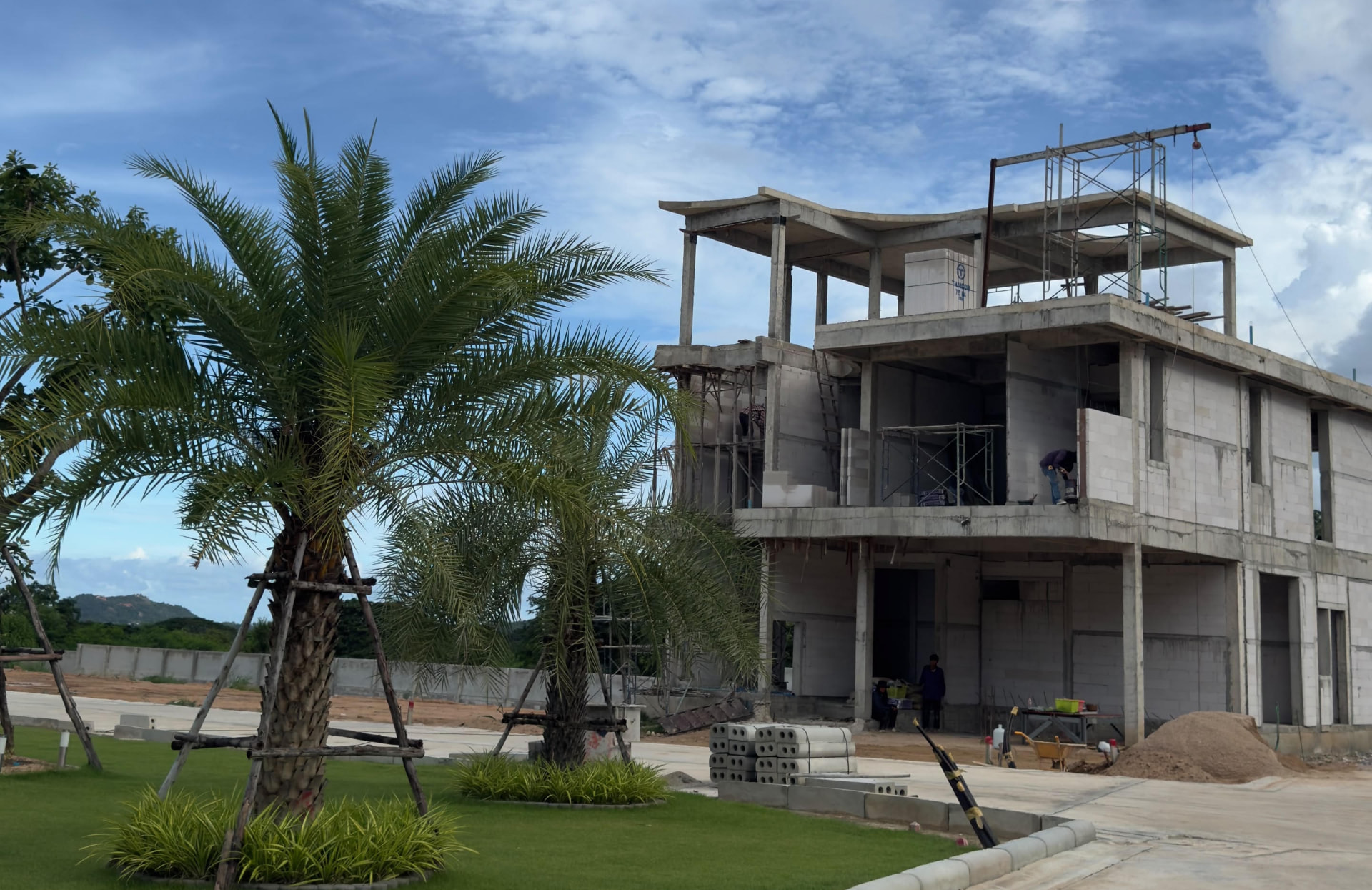
At The Vista Hua Hin, this legal integrity underpins the entire master plan. As a licensed residential development, each plot within the private collection of 12 residences is held under full Chanote title, ensuring that each home—from the single-storey V Series residences to the two-storey X Series residences—is anchored by unambiguous, GPS-surveyed land ownership.
Exclusive Private Residences
A private collection of architecturally distinctive residences in Hua Hin.
Explore the collection